Soothe Hypnotherapy Blogs
By Bran Malloch - Clinical Hypnotherapist
Personal blogs about hypnotherapy, mental health and general well-being
All views are my own. These blogs are for educational purposes only, and do not replace actual therapy.
Soothe Blog 1 - 11/08/2025
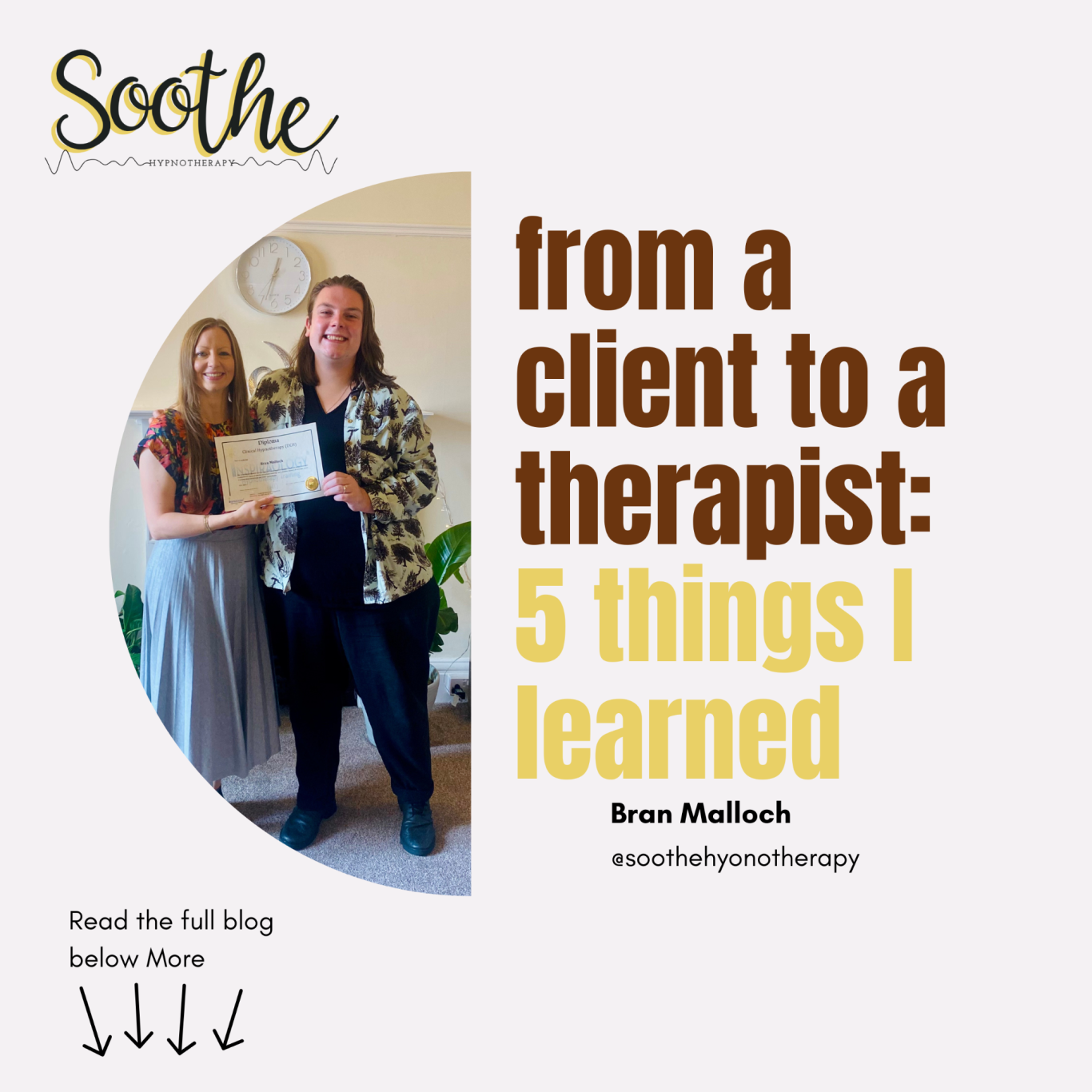
From a Client to a Therapist: 5 Things I Learned
A Soothe Hypnotherapy Blog by Bran Malloch
There was a time when simply leaving my front door felt like trying to drive a car without wheels - I was ready to go, but my vessel wouldn't let me. I'd always find that I’d have an urge to go to the toilet, that my lungs couldn't hold the air, or suddenly I didn't ‘need’ to go.
Agoraphobia didn’t just limit my life over the 10 years it controlled me; it shrank it. Social invitations were ignored (and when they weren't they were politely declined), chores were carefully planned or avoided, and I was coming to accept that maybe this was the way life was meant to be for me.
I thought I had tried everything. Then I discovered hypnotherapy
At first, I was skeptical. Could lying on a couch listening to a calm voice really undo years of fear? But as time went by, I was learning new things about myself and my brain. I wasn’t just coping - I was changing. After 13 weeks, I had gone from not being able to leave the house without a predetermined ritual, to standing in a forest and enjoying it (this was my worst nightmare previously). The turning point came when I realised I wanted to give others the same tools that had transformed me.
Today, I’m a qualified clinical hypnotherapist. This journey taught me far more than how to be a therapist; it's shown me that humans came with our own keys to unlock our goals, we just need to be encouraged to find them. Here are the five biggest lessons I learned along the way.
1 Your mind is more powerful than you think
For me, anxiety was rooted in the physical symptoms. The sweaty palms, the “emergency poos”, the shortness of breath. But becoming a therapist has allowed me to understand that those are natural responses to anxiety. The key to soothing this lies in the mind, not the body. Learning that the mind has the power to control these awful symptoms has changed my life, and helping others learn this is the most rewarding part of my job. I love showing clients that, through relaxation, repetition, and gently pushing your comfort zone, you can train your primitive mind that it's okay to take time off.
2. Progress is rarely linear
When climbing a mountain, the straightest way up never seems possible. The winding path to the top gets you there safely, and sustainable. The same goes for therapy. Even now, I still get anxious. We all do, and we all will. It's a chemical response to danger. Progress doesn't look like cutting anxiety out; it looks like learning how you respond to these chemicals when they arise. Trying new things will provoke a bodily response; the secret is learning that it's natural, and that you're in control, so give yourself permission to feel it, and when you're ready move on. And surely, over time, as you walk that winding path, you get to the top.
3. Make room for non-toxic positivity
Our prefrontal cortex is complex. Our right prefrontal cortex processes negative thoughts and analyses potential outcomes, helps inhibit what our brain sees as “negative” actions. Our left prefrontal cortex is similar, instead focusing on positive emotions and seeking reward, resulting in increased motivation and creative thinking. As a society, we'll exercise the right prefrontal cortex eagerly - tearing ourselves apart to understand the problem, or to hold ourselves back with “what ifs”. But the feeling of helping a client learn to exercise their left prefrontal cortex regularly - to help them find solutions and make meaningful steps to them - will never not feel rewarding.
It's not about being toxically positive, but using the brain to look for ways forward, ways to cope, or ways to accept the problems.
4. You deserve some time to relax.
A therapy which dedicates 50% of the session to relaxation sounds too good to be true. But alas, now I'm lucky enough to have a job which encourages people to get comfy and spend time with their thoughts in a relaxed environment. Our society is chronically under-rested, and people need to give themselves permission to relax. Hypnosis uses relaxation and guided meditation to focus the mind, as a space to rehearse your desired outcomes (forging new neural pathways), and a chance to regulate anxiety and rumination of negative thoughts. That's why half my sessions consist of trance, rest and relaxation unlocks change.
5. Our brains are cool
I hated my brain. It held me back, I thought it was broken. But the more I learned about it, the more I wanted to know. Neuroscience education underpins my approach to therapy, because once you understand why something happens you can begin to address how to alter it. I thought I was the problem, but once my therapist drew out the brain for me and showed me that it's not me, it's a part of the brain trying its best to protect me (badly, but with the best of intentions), I learned to be kinder to myself. I draw the same pictures for my clients now.
Conclusion.
Hypnotherapy didn’t just help me leave the house again - it gave me a life I love, and a career that feels deeply meaningful. My goal was to end up in a forest, in reality I have far surpassed that. I now drive, I go on road trips, I leave the house without even thinking about going to the toilet, or cancelling. I have control. I didn't write this blog for sympathy, or to stroke my own ego, but to explain my perspective on hypnotherapy. I am doing this to pay it forward, because I know that this therapy has the potential to change lives.